
Termites vs Wood Borers: How to Tell Them Apart and Save Your Furniture
How to tell wood borers (woodworm) from termites by the marks each one leaves, which home remedies do harm, and when your furniture needs professional treatment.
- Formax technical team
- 18 min read
In this article
- Termites vs wood borers: the difference in 10 seconds
- Wood borers: what they look like and how they live
- Signs of wood borers in your furniture
- Termites: why they are more serious than an insect in the wood
- Signs of termites in your home
- Popular home remedies: what works and what is dangerous
- How proper treatment works
- How to protect new wood and second-hand furniture
- The short version
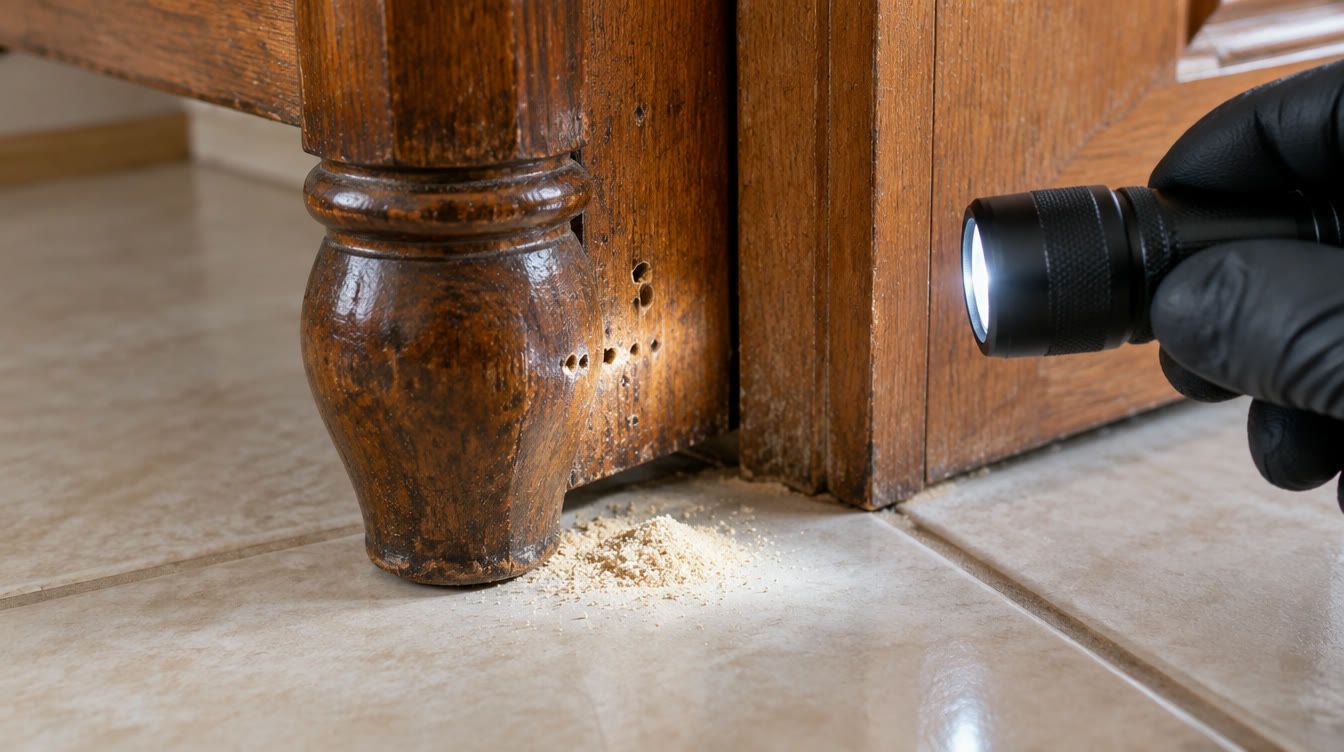
You find some fine dust under a chair leg, or a tiny hole in a wardrobe door. You wipe it away and forget about it. A few months later the same dust is back in the same spot. Or you notice a thin line of mud running up a ground-floor wall and have no idea where it came from.
Those are two very different problems. The first is usually wood borers (woodworm, in British English). The second is a classic sign of termites. People mix them up all the time and treat both the same way, sometimes with home remedies that do more harm than the insect.
This guide shows you how to tell them apart from the marks each one leaves, what you can safely do yourself, and when you need wood borer and termite control from a technician. We checked the facts against university and government extension bulletins, listed at the end.
Termites vs wood borers: the difference in 10 seconds
The quick answer: wood borers leave holes and powder, termites leave mud and hollow wood. You don’t need to catch the insect to use this table.
| Point of comparison | Wood borers (woodworm) | Termites |
|---|---|---|
| Type of insect | Small beetles, such as the common furniture beetle and powderpost beetles. Their larvae are what eat the wood | A social insect living in a large colony with workers, soldiers and winged reproductives |
| What they look like | A tiny brown beetle, usually under half a centimetre long, and rarely seen | Workers are white or cream with soft bodies. They look like ants but have no narrow waist |
| The sign they leave | Small round holes in the wood surface, with fine powder or tiny pellets underneath | Mud tubes on walls and foundations, wood that sounds hollow, and shed wings near windows |
| Where they live | Inside the wood itself: furniture, doors, picture frames, wooden floors, old ceilings | Mostly in the soil, reaching wood through tunnels. They favour damp places |
| How serious it is | They slowly weaken the infested piece and can move to other pieces in the same home | They can reach door frames, parquet, books and paper, and the damage stays hidden until it is large |
| Treatment | Injecting a registered product into the holes, treating the wood, and replacing badly eaten pieces | Soil treatment around the foundation or slow-acting baits, plus fixing the moisture source |
| Important exception | Their powder is fine, like flour | Drywood termites live inside the wood with no soil contact and leave dry pellets that are coarser than wood borer dust |
The row that matters most is the sign. Fine powder dropping from a small hole in a chair or a wardrobe usually means wood borers. A thin mud tube climbing a wall from the ground, or wood that gives way when you push a screwdriver into it, makes termites far more likely.
Location is another clue. Wood borers can turn up in a wardrobe on the tenth floor, because they arrive inside a piece of furniture. Termites that live in the ground (subterranean termites) need a path from the soil to the wood, so they usually start on ground floors, in basements, and wherever there is damp or a leak.
There is one exception. Some termites, known as drywood termites, don’t need soil at all. They live inside the piece of wood itself, just like wood borers, so you can find them on any floor, inside furniture or a door frame. Their sign is small, dry pellets falling from openings in the wood. These look a lot like wood borer dust, but they are coarser and you can make out the individual grains. If you find granules under a piece of wood and aren’t sure what they are, send us a photo before you decide anything, because the treatment is different.
One more source of confusion: in Egypt, the Arabic word “sous” gets used for all sorts of insects. The rice and spice weevils you find in the kitchen are a completely different insect that lives in food and has nothing to do with wood. And whatever is biting you in bed at night isn’t a borer at all. If you suspect bed bugs, read how to identify bed bugs and tell them apart from other insects.
Wood borers: what they look like and how they live
“Wood borer” is a name for several kinds of small beetle. The best known is the common furniture beetle (scientific name Anobium punctatum), whose larvae are the classic “woodworm”. There is also a group called powderpost beetles, which leave very fine dust, almost like flour. And there is the deathwatch beetle, which prefers damp wood.
The adult beetle
The beetle itself is very small, brown or reddish-brown, and cylindrical. Most people have never seen one, because it lives only a short time after it leaves the wood. Its main job is to mate and lay more eggs. The female looks for a small crack, an old hole or the open pores of bare wood, and lays her eggs there.
And yes, wood borers can fly. The adult has wings, and University of California bulletins note that powderpost beetles are drawn to light. That is why small dead beetles sometimes turn up on a windowsill, and most people never connect them to the furniture.
The larva: the stage that does the damage
The egg hatches into a small white larva that bores straight into the wood. The larva does the eating and digs the tunnels. It can stay inside for months or several years, depending on the species, the wood and how damp it is.
Meanwhile the surface can look completely sound. The tunnels inside fill up with packed powder, which is the larva’s droppings mixed with bits of wood.
Why you only see holes after the damage is done
When the larva is fully grown, it becomes a pupa close to the surface, then turns into an adult beetle that chews through the wood and leaves. The hole you see is called an exit hole. It is a way out, not a way in.
So the first hole you spot means larvae have been in that wood for a while. Sometimes the infestation started in the timber before it became furniture, or before you bought it, and years pass before anyone notices. Holes in furniture you have just bought don’t necessarily mean the problem came from your home.
The wood they like
Not all wood is equal to them. Powderpost beetles like hardwoods that contain starch, and they can survive in fairly dry wood. The furniture beetle prefers the softer outer layer of the tree (the sapwood) and becomes more active as humidity rises. The deathwatch beetle needs damper wood, so it shows up more in closed rooms, basements and wooden ceilings with leaks.
The common factor is moisture. Wood in a damp room, or pushed up against a wall with rising damp, is more likely to be infested than the same wood in a dry, airy room.
Signs of wood borers in your furniture
If you’re looking for signs of woodworm, check 4 things. None of them alone proves the infestation is still active, but together they tell you a lot.
Small piles of fine powder
This is the sign people notice most often. Fine wood dust collects under a chair leg, on the shelf below a drawer, or on the floor beside a door frame. The texture of the powder gives a hint about the beetle. Powderpost beetles leave very fine dust, like face powder. Other species leave tiny pellets that feel gritty between your fingers.
There is a catch, though. An Iowa State University bulletin points out that powder falling from the holes isn’t proof on its own that the infestation is still active. A knock or a vibration can shake old powder out of empty tunnels. If you wipe the powder away and it comes back in the same place weeks later, activity becomes much more likely.
New holes or old ones?
The holes are small and round, roughly the size of a ballpoint pen tip. If a hole has light, clean edges and the wood inside is still pale, it is probably new. Old holes darken with time and sometimes fill with dirt, or with varnish from an earlier coat of paint.
Universities recommend a simple test. Mark the existing holes in a small area, or seal them with wax or wood filler, and check again a few months later. New, unmarked holes mean the infestation is active. It is slow, but it separates a piece that needs treatment from one with only old damage.
Weak or crumbling wood
In older infestations, the inside of the wood is full of tunnels. If you press the edge with a screwdriver or a nail, it may sink in easily or crumble. You see this most on legs, edges and unpainted areas. Well-painted wood hides the damage until the surface itself starts to fall away.
A ticking sound at night
This sign is less common, and we mention it with caution. The adult deathwatch beetle taps its head against the wood to call a mate, which makes a faint ticking sound, usually in the quiet of the night. It belongs to one species that likes damp wood, and it doesn’t happen with every kind of wood borer. So if you hear nothing, that doesn’t mean the wood is healthy.
Places you should check
If you find a sign on one piece, check the pieces around it. Remember that the beetle flies and lays eggs in other wood. Start with second-hand or old furniture, then doors and their frames, picture frames, the unpainted backs of wardrobes, and wooden floors in damp rooms. Don’t forget wooden boxes and crates stored on the balcony or the roof.
Termites: why they are more serious than an insect in the wood
People sometimes call them white ants, but termites aren’t ants at all. They are social insects organised in a completely different way, and that is why they are much harder to deal with than wood borers.
A colony, not a single insect
With wood borers, each larva works alone in its own tunnel. Termites work as a colony. A Rutgers University bulletin describes the colony as having a king and queen that reproduce, workers that make up most of the colony, and a small number of soldiers. The workers are white, soft and wingless. They eat the wood and feed the rest of the colony. Soldiers have larger, brownish heads and big jaws, and their job is defence.
At certain times of year, darker winged termites emerge and fly off to start new colonies. Once they land, they drop their wings. Sometimes those shed wings by a window are the first thing a homeowner notices.
Why soil and moisture matter
Subterranean termites, the kind usually found in homes, need moisture all the time. Their soft bodies dry out quickly in open air. That is why they live in the soil and reach wood through closed tunnels.
When the wood is some distance from the soil, they build tubes of mud. The University of California bulletin says these are made of soil, wood particles and the insects’ saliva. The tubes run up foundations and walls, inside cracks and behind skirting boards, and they shield the termites from light and dry air as they travel back and forth between the colony and the wood.
Damage you can’t see
Termites eat wood from the inside, along the grain. They eat the softer parts and leave the harder layers, so the inside ends up looking like a stack of thin sheets. They usually leave a thin outer shell untouched, which is why the damage stays out of sight until someone presses on the wood or knocks on it.
The spots they reach most often are close to the ground or to moisture: the bottoms of door frames, skirting boards, parquet and wooden wall panelling. They also go for anything containing cellulose, such as books, paper and cardboard boxes left on the floor of a storeroom or basement.
When the risk is higher in Egypt
We haven’t found reliable published figures on how common termites are in Egyptian homes, so we won’t quote any numbers. The conditions that help them are well known, though. Think of older buildings with plenty of wood in the floors and ceilings, and ground-floor flats with rising damp or a leaking pipe. Villas and houses with gardens are also at risk, particularly where soil touches the walls or timber is stacked against the boundary wall.
Not every house with a garden will get termites. It is still worth checking now and then.
Signs of termites in your home
If you suspect termites, these are the signs to look for. Start with the places closest to the ground and to water.
- Mud tubes on a wall or foundation: thin lines of mud running upwards from the ground. The Rutgers bulletin says an active tube is darker and damp, while an old one is dry and breaks easily.
- Shed wings: small, see-through wings, all the same length, gathered on a windowsill, by a door or under a light. This happens after the winged termites fly and land.
- Winged insects flying indoors. What sets them apart from flying ants is that a termite’s four wings are roughly equal in size, its antennae are straight and look like a string of beads, and its waist is broad rather than pinched like an ant’s.
- Wood that sounds hollow: tap on a door frame or skirting board. If it sounds empty, or a screwdriver sinks in easily, that needs a proper inspection.
- Bubbling or peeling paint on wood. The moisture termites bring with them can make paint or wallpaper blister so it looks like water damage.
- Doors and windows that suddenly start to stick. When wood is eaten away or gets damp, the frame can shift and the door becomes hard to close.
- Paper or cardboard eaten from below: books or documents stored on the floor that look fine on top but are eaten underneath, with traces of mud.
If you find more than one of these signs, don’t break the tubes and don’t spray anything on them before an inspection. The tubes show the technician the route the termites are taking. If they are broken or hit with a random insecticide, the colony will usually just change its route.
Popular home remedies: what works and what is dangerous
The moment people find borers in their furniture, they look for a quick fix at home. A few of these remedies have a real basis. Others sound sensible and are dangerous.
Sunlight helps, but it is not a treatment
Plenty of people put a chair or a wooden chest out in the sun for a few days. The sun heats and dries the wood, and dry wood is less attractive to some species. But there is no guarantee the heat gets deep enough into thick wood, at a high enough temperature and for long enough, to kill the larvae. Universities talk about heating in controlled chambers or kilns, not on a balcony. Direct sun can also crack the wood or spoil the varnish.
Freezing small items
This is one of the few remedies with real backing. The University of California bulletin mentions that small wooden items can go into a freezer at a deep-freeze temperature for a few days, with thicker pieces needing longer. That works for a small picture frame, a wooden box or an ornament. It won’t work for a wardrobe or a bed. It kills what is inside, but it doesn’t protect the piece from a new infestation later. If the item has fabric, leather or a delicate finish, ask before you try it.
Spraying insecticide on the surface
Ordinary sprays kill the adult beetle if they touch it, but they don’t reach the larvae inside the tunnels. The University of California bulletin also explains that wood finished with varnish or paint can’t be treated properly from the surface, because that coating stops the product soaking in. You can empty a whole can and the infestation stays exactly as it was.
Kitchen mixtures and oils
Vinegar, salt, essential oils and the like. There is no credible evidence that any of them reach larvae inside wood or affect a termite colony underground, and some stain the wood or leave a smell.
Termites in particular: don’t experiment
With termites the stakes are higher, because the colony is in the soil, not in the piece of wood in front of you. Spraying the tubes kills a few workers, and the rest simply take another route. The U.S. Environmental Protection Agency advises that soil treatment with termiticides is best left to a licensed professional, because incorrect application can contaminate the home and the groundwater. If you suspect termites, photograph what you see and send it to a specialist before doing anything else.
How proper treatment works
Proper treatment starts with one question. Is this wood borers in a few pieces of furniture, or termites coming up from the soil? The answer changes the whole plan, which is why any termite or wood borer control has to start with an inspection.
Inspection and moisture assessment
The technician examines the infested pieces and the ones around them, sorts new holes from old ones, and taps on the wood to find the weak spots. With termites, the technician follows the tubes back to where they start. We also look for moisture: a leaking bathroom, a dripping pipe, damp in a wall, garden soil piled against the foundation. Until that is fixed, any treatment is temporary.
Treating wood borers: injection and wood treatment
With wood borers, the whole point is getting the product inside the tunnels, so we inject a registered product into the exit holes themselves, so it travels through the tunnels where the larvae live. Then we treat bare wood, such as wardrobe backs, drawer undersides and unpainted areas, so beetles that emerge later have nowhere to lay eggs.
With valuable or antique furniture, we inspect first and tell you plainly whether the piece can be treated where it stands or needs a different approach.
Treating termites: soil and baits
Termites can’t be treated through the wood alone. University bulletins and the EPA describe two main approaches. The first is treating the soil around the foundation with a product that forms a barrier, so termites coming from the ground can’t cross it. The second is baits containing a slow-acting ingredient that workers eat and carry back to the rest of the colony. Which approach fits depends on the building and where the infestation is, and sometimes both are used together.
Fixing the moisture and replacing damaged wood
A badly eaten beam won’t become sound again after treatment. Treatment stops the insect, but the wood that was eaten is gone. If a door frame or a ceiling beam has lost its strength, the safe choice is to replace it. The new wood that goes in should ideally be treated and kept away from contact with soil and damp walls.
After treatment there is a follow-up visit every 3 months. These visits matter most with wood borers, because beetles that were still larvae at the time of treatment can emerge afterwards. The follow-up confirms that no new holes have appeared and that the moisture source really has been closed off.
How to protect new wood and second-hand furniture
Prevention costs far less than treatment, and most of it is habit.
Inspect second-hand furniture before it comes in
This is the most important advice in the whole article. The University of California bulletin recommends inspecting furniture and wooden items before they come into a building. Before you buy an antique sofa or a wardrobe from a second-hand market, turn it over and look at the legs, the back and under the drawers. If there are holes with light edges, or powder falls out when you shake it, either leave it or have it treated before it sits next to your other furniture. Send us photos on WhatsApp and we will identify the insect for free, so send them before you pay.
Keep wood dry and well ventilated
Moisture is what opens the door to both pests. Fix any leak quickly, keep bathrooms and kitchens ventilated, and don’t push wardrobes against a wall with rising damp. Leave a small gap between the back of the wardrobe and the wall so air can move. If you have a damp basement or storeroom, don’t store wood or cardboard boxes directly on its floor.
Paint or varnish every face
Beetles lay their eggs in the open pores and cracks of bare wood. Paint and varnish seal those pores. The trouble is that carpenters sometimes finish only the visible face and leave the back and the underside of drawers as raw wood. Ask for every face to be sealed, especially in kitchens and in wardrobes that will be fitted in damp spots.
Keep wood off the ground and away from soil
This one is mainly about termites. Don’t store timber or firewood on the ground beside the wall of the house. Keep garden soil and plants away from the foundation and walls. Garden woodwork, such as pergolas and fences, should be treated and not set straight into the soil. If you are building a new house, ask the contractor about treating the soil before the concrete is poured.
Take a look every so often
Every few months, open the old wardrobes and look at the floor under them, and check the walls and foundations on the ground floor. Five minutes now can save a wardrobe or a door frame later.
The short version
Wood borers and termites both eat wood. Beyond that, they have very little in common. Wood borers are beetles that come into your home inside a piece of furniture, and their signs are holes and powder. Termites are a colony that comes up from the soil, and their signs are mud and hollow wood. Treating either one starts at the same point: work out which one you have, and find the source of the moisture.
If you have spotted any of the signs we covered, take a photo and send it to us, and we will tell you what it is for free. If you need a visit, you can read about our wood borer and termite control service, or get in touch through our contact page at any time. We work 24/7 across all 27 governorates of Egypt, our team answers in Arabic and English, and the work comes with a written 5-year guarantee.
Frequently asked questions
What is the best way to get rid of woodworm and weevils at home?
Start by finding out which insect you have, because wood borers and rice or spice weevils are different pests. Wood borer larvae live inside the wood, so a surface spray only kills the flying beetles. Injecting a registered product into the holes and treating the wood reaches the larvae, and small items can be frozen. For kitchen weevils, throw out infested food, clean the cupboard and keep grains in airtight containers.
Can wood borer beetles fly?
Yes. The adult beetle has wings, which is how an infestation spreads from one piece of furniture to another in the same home. Most of its life is spent as a larva inside the wood, out of sight and unable to fly. When it is fully grown it bores its way out, and many adults fly towards light, so small dead beetles on a windowsill are a common clue. If you see them near wooden furniture, look for fresh holes.
What is the difference between bed bugs and woodworm?
Bed bugs feed on blood and live in beds and sofas; their signs are bites on your skin and black spots on the mattress. Woodworm is the larva of a wood-eating beetle and never bites people. If you wake up with bites, suspect bed bugs. Small holes and powder under a chair point to wood borers, and tiny insects in a bag of rice or flour are pantry weevils.
What does it mean if I find woodworm in my house?
Usually it means a piece of wood was already infested when it came in, such as second-hand furniture or timber that was never treated before it was made up. It can also mean extra moisture is making the wood attractive to them. It does not mean your home is dirty. Pantry weevils point to grains or flour kept too long or bought already infested. Either way, find the source and isolate it.
What actually kills wood borers?
Wood borers die when a treatment, or enough heat or cold, reaches the larvae inside their tunnels rather than just the surface. Technicians inject registered products into the exit holes and treat bare wood, and small pieces can be frozen or heated under control. Varnished wood will not soak up a product from the surface, so injecting into the holes matters. Badly eaten wood should be replaced.
Are wood borers the same as rice and spice weevils?
No, they are completely different insects. Rice and spice weevils are small beetles that live in stored food and leave wood alone. Wood borers live in furniture, doors and floors, and leave holes and powder behind. You deal with kitchen weevils by throwing away infested food, cleaning the shelves and using sealed containers. Wood borers need the wood itself treated, so identify the insect before you buy any product.
Sources
The scientific information in this article was checked against these sources:
- Wood-Boring Beetles in Homes (Pest Notes, Publication 7418) · UC Statewide IPM Program, University of California
- Subterranean and Other Termites (Pest Notes, Publication 7415) · UC Statewide IPM Program, University of California
- Powderpost Beetles · Iowa State University Extension and Outreach
- FS338: Termite Prevention and Control · Rutgers New Jersey Agricultural Experiment Station
- Termites: How to Identify and Control Them · U.S. Environmental Protection Agency (EPA)
Formax technical team
This article was written and reviewed by the technical team at Formax German Pest Control: the technicians who inspect and treat homes and businesses in every governorate in Egypt. The scientific information was checked against the sources listed above.
More about FormaxRead next
-
Termites & wood borers with Formax
How we treat it, number of visits, the guarantee and the price.
- Article
What Do Bed Bugs Look Like? Eggs, Nymphs, Bites and How to Confirm an Infestation
What adult bed bugs, nymphs and eggs look like, how the bites differ from mosquito and flea bites, 7 signs that confirm them, and a 10-minute flashlight check.
- Article
How to Get Rid of Cockroaches for Good: Gel or Spray? A Kitchen and Bathroom Guide
How to get rid of small cockroaches in the kitchen and drain cockroaches in the bathroom: identify the type, use gel properly and spot which home remedies are myths.